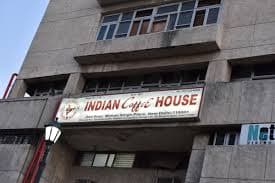
Indian Coffee House
Connaught Place's cathedral of democratic debate — where India's independence was argued over filter coffee
Indian Coffee Workers' Co-operative Society
Founder · Est. 1957 · Connaught Place, Delhi NCR
The Indian Coffee House on Baba Kharak Singh Marg opened in 1957 as part of the national chain established by the Indian Coffee Workers' Co-operative Society — itself born from a worker-led takeover of the Coffee Cess Committee's chain. The café was never intended as a commercial enterprise in the conventional sense. It was, from inception, a co-operative: owned by the workers, run by the workers, priced for the public.
Through the decades that followed, the Connaught Place branch became the informal headquarters of Delhi's intellectual life. Journalists from the nearby Bahadur Shah Zafar Marg press district, professors from Delhi University, lawyers from the Supreme Court, poets, political workers, and students occupied its tables — not for the coffee, which is functional rather than exceptional, but for what the space permitted: long occupation at minimal cost, and conversation without commercial pressure.
The waiters wear the distinctive white turban that is the uniform of every Indian Coffee House branch nationwide. The menu has not changed in substance since the 1960s. The filter coffee arrives in the same steel tumbler-davara set. The prices remain among the lowest of any sit-down establishment in central Delhi.

“This is a workers' co-operative. The coffee pays the workers. The workers serve the coffee. Everything else is conversation.”
What Defines Indian Coffee House
The Experience
The interior is large, fluorescent-lit, and entirely without decoration in the contemporary sense. The tables are formica. The chairs are wooden. The noise level is the noise of people arguing, discussing, and debating — which is what this space was built for. There is no music. The atmosphere is the conversation.
Rated & Reviewed By
Condé Nast Traveller India · Times Food Heritage · Lonely Planet India · Zomato 4.0★
Editorial Notes
- The co-operative ownership model — workers own and operate the café — is one of India's most sustained examples of worker-led hospitality.
- The Connaught Place branch is one of the last surviving branches in Delhi; several have closed over the past decade.
- The turban-wearing waiters are the most recognisable uniform in Indian café culture.
- Mandatory curriculum reference for hospitality students studying co-operative business models in food service.
- The café's location on Baba Kharak Singh Marg places it adjacent to the Hanuman Mandir and within walking distance of Parliament.
Getting There
Nearest Metro: Rajiv Chowk (Yellow/Blue Line, 5-minute walk). The café is on Baba Kharak Singh Marg, adjacent to Mohan Singh Place, inner circle of Connaught Place.